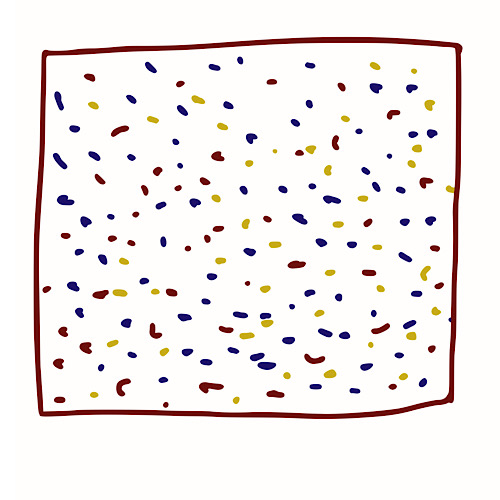
There is an understandable temptation to describe this work as a field of coloured marks enclosed within a border. Such a reading, while technically defensible, mistakes appearance for ontology.
For Van Gogh (Not That One), the individual mark is never autonomous. It exists only in relation to the infinitesimal hesitation separating it from its neighbours. The work therefore occupies what the artist has referred to elsewhere as “the ethical interval between almost-touching and definitely not.” The image is less a composition than a census of avoided encounters.
The enclosing line deserves particular attention. It is not, as one might initially suppose, a frame. Rather, it functions as a diplomatic boundary, establishing a temporary sovereignty within which chromatic events are permitted to occur free from the coercive expectations of narrative. The rectangle is not containing the marks; the marks are, in a profound sense, holding the rectangle together.
The restrained palette that includes burgundy, ultramarine and cadmium yellow appears at first to invoke modernist colour theory, but quickly resists such categorisation. Instead, each pigment performs a subtle redistribution of perceptual authority. Blue behaves as if it were remembering. Yellow arrives fractionally too late. Burgundy, meanwhile, declines the invitation to visit at all.
One becomes increasingly aware that no mark occupies the exact centre of the work. Whether this absence was calculated or merely discovered is impossible to determine and, in the context of Van Gogh (Not That One)’s practice, perhaps the wrong question entirely. The centre is not missing; it has simply dispersed itself evenly across the surface.
There is also a curious temporal instability. The painting seems equally capable of depicting the first instant after creation and the last instant before dissolution. It is impossible to tell whether the marks are settling into place or preparing to leave. This ambiguity constitutes the work’s quiet triumph.
Several critics have compared the piece to language, while others have insisted it is closer to weather. Both positions underestimate its ambition. It is perhaps more accurate to regard it as a failed attempt by a geometry professor to remember jazz.
As with much of Van Gogh (Not That One)’s recent output, the painting rewards sustained viewing. After twenty minutes the marks begin to organise themselves into loose constellations. After forty, they refuse even that concession. By the end of an hour, many visitors report the peculiar sensation that it is they who have become randomly distributed while the painting has remained perfectly still.
Whether this represents aesthetic transcendence or simply excellent gallery lighting remains, appropriately, unresolved.